Article VI Additional Standards for Specific Uses
Section 600 Home Businesses.
600.1 Performance Criteria.
A home business shall not materially disturb the total residential environment and shall comply with the criteria listed herein. When a home business grows beyond these limits, it shall be required to seek facilities other than the home. If more than one business is conducted on the premises, all of the businesses together shall not exceed these criteria.
- A. A home business is any activity carried out for financial or material gain by a resident conducted as an accessory use in the resident's dwelling unit or accessory structure. Examples of home businesses include but are not limited to: woodwork, massage, attorney, engineer, and tailor.
- B. The business shall be carried on by a person only within the dwelling used by him or her as his or her private residence, or within an accessory structure.
- C. The business shall not occupy an area greater than 25% of the finished floor area of the dwelling.
- D. The business shall employ no more than two persons working on the premises other than family members living in the dwelling.
- E. The business shall not have window displays, window advertising or any other advertising, except an identification sign complying with Section 608.4.B.
-
F. The business shall not detract from the residential character of the neighborhood. It shall not:
- 1. Generate non-residential levels of noise, vibration, glare, smoke, dust, fumes, odors, or heat.
- 2. Generate more than an average of two (2) vehicular trips per hour to the premises for each hour the business is open or peak of six (6) vehicles per hour.
- 3. Require more than two (2) off-street parking spaces beyond those required by the dwelling (see Section 607, Table of Minimum Off-Street Parking).
- 4. Generate non-residential truck deliveries more than twice per week.
- 5. Utilize the exterior spaces of the residential structure or yard for storage, display or occupational activities that deviate from typical residential use.
- 6. Involve the overnight parking of more than one business car or other business vehicle on the premises.
-
G. The following uses, by nature of the investment or operation, have a potential to rapidly increase beyond the limits specified and impair the use, value and quiet enjoyment of adjacent residential properties: retail stores, vehicular sales, vehicular repair, restaurants, sandwich shops, and on-site commercial recreation. By their nature these uses are more appropriate in zoning districts that allow them and, therefore, are not permitted as home businesses.
Retail sales of products that are generated by or incidental to an approved home business shall be permitted. Examples include but are not limited to the sale of hair care products as part of a hair salon home business, and the sale of items created as part of a woodworking home business.
600.2 Permits.
Every home business shall require a permit from the Zoning Administrator. The permit shall completely describe the type of business activity being carried on; the parts of the dwelling devoted to residential use; and any limitations thereon. The applicant shall provide evidence to the satisfaction of the Zoning Administrator that the criteria of Section 600.1 are met.
The use of a room in a dwelling as a home office by a resident/occupant shall be exempt from this section, provided that the use does not generate any traffic such as (i) deliveries or pickup of supplies or materials in excess of normal residential use, or (ii) clients/customers coming to the property.
Section 600A Home-Based Contractor’s Yard.
600A.1 Purpose.
The purpose of this section is to permit home-based contractor’s yards where the operation of such uses will not materially disturb the total residential neighborhood environment.
600A.2 Special Exception Required.
- A. Where permitted under Article III, a home-based contractor's yard shall require a special exception.
- B. A special exception shall be granted upon demonstration of compliance with the following standards, in addition to the general special exception criteria set forth in Section 801.3:
- 1. The property at which the home-based contractor's yard is proposed to be located is a minimum of one (1) acre in size.
- 2. The operator of the home-based contractor's yard shall be a resident of the property on which the contractor's yard is located.
- 3. Other than the operator, no more than two (2) persons may work on the property at one time. This restriction shall not apply to members of the operator's family who also reside on the property.
- 4. The operator's business shall not have window displays, window advertising or any other advertising, except an identification sign complying with Section 608.4.B.
- 5. A minimum of one (1) off-street parking space shall be provided plus one (1) off-street parking space per each non-resident employee who parks at the property. No more than two (2) parking spaces may be used for non-resident employee parking. Parking spaces shall meet the requirements of Section 201.7 and all applicable requirements of Section 607.
-
6. The operation and presence of the contractor's yard shall not detract from the total residential character of the neighborhood. It shall not:
- a. Generate non-residential levels of noise, vibration, glare, smoke, dust, fumes, odors, or heat.
- b. Use on-street parking.
- c. Generate non-residential truck deliveries more than twice per week.
- 7. No more than three (3) motor vehicles used in connection with the home-based contractor's yard may be parked on the property at any one time. Motor vehicles must be 26,000 lbs GVWR or less. The parking of an employees' personal motor vehicle shall not count towards the maximum.
-
8. In order to further ensure that a home-based contractor's yard will not materially disturb the total residential neighborhood environment, the outdoor storage of business equipment, the overnight outdoor parking of motor vehicles used in connection with the home-based contractor's yard, and outdoor work areas:
- a. shall be permitted in the side and rear yards only;
- b. shall not be permitted within minimum required yards;
- c. shall occupy no more than 10% of the total acreage of the property nor exceed one (1) acre whichever is less, exclusive of areas covered by buildings; and
- d. shall be screened from view from abutting residential properties and public streets.
The Zoning Board of Adjustment may waive any of the requirements in this subsection (Section 600A.2.B.8) when it determines that the purpose of the requirement can be reasonably and adequately addressed by alternative means.
Notwithstanding the foregoing, one motor vehicle used in connection with the home-based contractor's yard may be stored overnight within the front yard in accordance with Section 201.7 and Section 600A.2.B.4.b, without required screening from abutting residential properties.
Section 600B Home-Based Agricultural Business.
600B.1 Purpose.
To allow limited agricultural business activities in the R-1, R-2, and R-3 Districts.
600B.2 Chickens, Bees, and Products Grown On-Site.
For lots of 5 acres or more in the R-1, R-2, and R-3 Districts, activities allowed include the sale of products associated with raising chickens (per Section 611), bees (per Section 611A), and the harvesting of products resulting from activities identified in Section 200. Products must be grown on-site and may be sold in either raw or value-added forms. Educational programs directly related to the on-site agricultural activities are permitted. For lots of less than 5 acres, a special exception is required.
600B.3 Poultry and Livestock.
- A. In the R-3 District, on lots between 5 and 10 acres in size, the keeping of poultry other than chickens is allowed as part of an agricultural business.
- B. In the R-3 District, on lots greater than 10 acres, the keeping of poultry other than chickens and the keeping of livestock is allowed as part of an agricultural business.
- C. For purposes of this section, "poultry other than chickens" shall mean ducks, turkey, geese, and guinea fowl, and "livestock" shall mean horses, cattle, goats, sheep, llamas, and alpacas.
600B.4 Operational Standards.
- A. The operator of the homebased agricultural business shall be a resident of the property on which the business is located.
- B. All agricultural activities associated with a homebased agricultural business must be conducted in accordance with the Manual of Best Management Practices (BMPs) for Agriculture in New Hampshire (available on-line at https://www.agriculture.nh.gov/divisions/regulatory-services/nutrient-management.htm), and shall comply with all applicable New Hampshire statutes and regulations including but not limited to NH RSA 644:8 (Cruelty to Animals).
- C. Table 600B.4 establishes the minimum required area requirements for various species. The minimum secure enclosure area shall not include any areas within 20 feet of a dwelling unit on the same lot.
- D. Livestock shall be kept such that no nuisance results.
- E. Animal waste shall not be stored within one hundred (100) feet of any property line.
- F. All livestock and poultry must be kept within a secure enclosure which meets or exceeds the recommendations of the UNH Cooperative Extension.
- G. All livestock and poultry shall have available shelter which meets or exceeds the recommendations of the UNH Cooperative Extension. No shelter or enclosure, including pastures, shall be located closer than 100 feet to a property line.
-
H. The home-based agricultural business shall not:
- 1. Employ more than two persons working on the premises other than family members living in the dwelling.
- 2. Have window displays, window advertising or any other advertising, except an identification sign complying with Section 608.4.B.
- 3. Detract from the residential character of the neighborhood by creating levels of noise beyond those normal to the agricultural activities being conducted, vibration, glare, smoke, dust, fumes, odors, or heat.
- 4. Generate more than an average of two (2) vehicular trips per hour to the premises for each hour the business is open or peak of six (6) vehicles per hour.
- 5. Require the use of on-street parking.
- 6. Require more than two (2) off-street parking spaces beyond those required by the dwelling and the employees of the business (see Section 607, Table of Minimum Off-Street Parking).
- 7. Generate non-residential truck deliveries or pick-ups more than twice per week.
| Table 600B.4 Maximum Number of Animals and Minimum Secure Enclosure and Shelter Requirements | Maximum Animals | Minimum Secure Enclosure / Minimum Pasture | Minimum Shelter |
|---|---|---|---|
| Horses/cattle | First 10 acres, 1 animal; each additional 2 acres, 1 additional animal | 500 sq. ft. per animal / 1 acre per animal | 120 sq. ft. per animal, 3 sided |
| Goats, sheep, llamas, alpacas | First 10 acres, 6 animals; each additional acre, 1 additional animals | 50 sq. ft. per animal / 1 acre per animal | 20 sq. ft. per animal, 4 sided |
| Poultry other than chickens | More than 5 acres, up to 2 birds per acre | 20 sq. ft. per bird | 6 sq. ft. per animal, 4 sided |
600B.5 Zoning Permit Required.
A home-based agricultural business requires a zoning permit from the Zoning Administrator which must be applied for and issued prior to the operation of the business. The applicant shall provide evidence to the satisfaction of the Zoning Administrator that the applicable criteria of Section 600B are met.
The zoning permit shall describe the type of business activity that is approved and any limitations thereon, and shall be issued to the applicant together with a copy of the Manual of Best Management Practices (BMPs) for Agriculture in New Hampshire and the UNH Cooperative Extension guidelines referenced above.
Section 601 Special Design Standards.
The remodeling of a residential structure and other buildings existent as of the 2013 amendment to this section for certain uses identified in the R-2, R-O, and R-O-1 District Tables of Uses, and the construction of new buildings for certain uses identified in the R-O-1 District Table of Uses, shall comply with the following provisions:
601.1 Architecture.
Remodeling for conversions shall not alter the appearance of the exterior of the structure in a manner that is not compatible with the architectural character of the existing building; of abutting properties; or of the neighborhood. New construction shall be compatible with the architectural character or the abutting properties and neighborhoods.
For the purpose of this subsection only, the term “compatible” shall mean having architectural style or design; scale; exterior finish and treatment; site work; and landscaping consistent with that which exists in the neighborhood, on abutting properties and on the structure being remodeled, as applicable.
601.2 Parking & Access.
Adequate off-street parking shall be provided on the lot, unless off-premise parking is approved pursuant to Section 607.4. Such parking shall not occupy the front yard except within parking areas existent as of the 2013 amendment to this section.
601.3 Coverage.
Impermeable coverage plus unpaved parking and driveway areas shall not exceed 65 percent of the lot area.
601.4 Density.
The conversion or new construction of multi-family shall comply with the zoning district requirement for “Additional Area Per Dwelling Unit After Two.”
601.5 Additions To Existing Buildings.
Such remodeling may include expansion of the building by special exception provided that:
- A. The architectural compatibility requirements of Section 601.1 are complied with.
- B. Such addition shall not materially diminish the air and light available to abutting structures or materially reduce the openness of the neighborhood.
601.6 Accessory Buildings.
In zoning districts where such conversions are allowed, an accessory building existent as of the 2013 amendment to this section, may be converted to multi-family dwelling unit(s) or an office use by special exception.
601.7 (Reserved).
601.8 Replacements of Destroyed Structures.
In the R-2, R-O and R-O-1 Districts, a building erected as a replacement of a dwelling which existed as of the 2013 amendment to this section, may be converted to an office use by special exception, provided all requirements of Section 601 and Section 801.3 are met. This includes the requirement of Section 601.1–i.e., that the new building be architecturally compatible with the abutting properties and neighborhood.
Section 602 Non-Commercial Swimming Pools and Hot Tubs.
602.1 General.
A non-commercial swimming pool or hot tub which is designed to contain water depth of 24 inches or more shall not be located, constructed or maintained on any lot or land areas, except in conformity with the requirements of this Ordinance. Any existing pool not in conformance with these regulations shall be discontinued.*
Note: Section 603.3 of the July 19, 1978 zoning Ordinance required that all non-complaint swimming pools be discontinued by July 18, 1983.
602.2 Siting Criteria.
- A. Such a pool or tub shall be located in a rear or side yard unless the Board of Adjustment, by special exception, allows the pool/tub to be located in the front yard.
- B. Such pool or tub shall be not less than 15 feet from side and rear lot lines.
602.3 Fencing.
A. In-Ground:
Every in-ground non-commercial swimming pool or hot tub shall be entirely enclosed with a chain link, stockade type, or other equivalent fence of not less than four (4) feet in height measured from the ground level, unless a special exception is granted.
B. Above-Ground:
- 1. Every above-ground pool or hot tub with sides less than 4 feet above the finished grade shall be fenced in accordance with the requirements for in-ground pools.
- 2. Above-ground pools with sides at or greater than 4 feet above the finished grade shall be secured with a locking gate, locking/removable ladder, or the like, unless in conformance with Section 602.3.B.1.
602.4 Water Supply.
- A. If the water for such pool/tub is supplied from a private well, there shall be no cross-connection with the public water supply system.
- B. If the water for such pool/tub is supplied from the public water supply system, the inlet shall be above the overflow level of said pool. Backflow prevention devices shall be installed when determined to be required by the City.
602.5 Lighting.
No lighting or spot lighting shall be permitted which will shine directly beyond the bounds of the property or lot where such pool is located.
602.6 Permits.
- A. Every non-commercial swimming pool or hot tub shall have a permit from the Zoning Administrator.
- B. No permit shall be granted for the installation or construction of such swimming pool unless the plans shall meet the minimum construction requirements of the City has determined that the drainage of such pool is adequate and will not interfere with the public water supply system, with existing sanitary facilities or with the public streets.
Section 603 Senior Housing Complexes and Workforce Housing.
The Board of Adjustment may grant a special exception to allow a senior housing complex or a development with workforce housing to have a greater density than that specified for the applicable zoning district. Senior housing complexes may include congregate living facilities, subject to granting of a special exception by the Board of Adjustment.
Section 604 Group Day Care Facilities.
604.1 Play Area.
- A. There shall be a fenced outside play area which shall be free from hazards such as hidden corners; unprotected pools, wells, and steps; poisonous plants such as poison ivy, foxglove, and rhubarb; farm or lawn machinery or implements.
- B. It shall contain at least 50 square feet of usable play space per child using it, and the average width shall not be less than eight feet. Play areas shall not be permitted in front yards.
- C. By special exception, the Board of Adjustment may waive the requirement for a fence or the requirement that the play area not be in the front yard.
604.2 Other Requirements.
- A. A suitable loading and unloading area shall be provided for those children for whom the facility provides transportation. This area shall be in addition to required parking areas.
- B. Group day care facilities shall comply with all applicable state and federal regulations.
- C. Parking: One (1) parking space for each employee and one (1) parking space for every eight (8) clients shall be provided on site.
604.3 Home-Based Care Home.
Home-based care (family day care and family group day care home) is allowed as an accessory use to any primary residential use as long as all requirements for such programs adopted in rules of the New Hampshire Department of Health and Human Services (He-C 4002) are met, and no zoning permit is required, provided that persons living off the premises are not employed. If persons living off the premises are employed, such child care is a home business subject to the requirements of Section 600 (home business permits).
The care in the home of more than six (6) children (inclusive of any children under 6 years old who live in the home) is a group day care facility under this Ordinance.
Section 605 Junkyards.
Junkyards are allowed only in the Industrial Heavy (IND-H) zoning district, and only as a special exception.
605.1 Lot Area.
The minimum lot area shall be the greater of 150,000 square feet or the minimum lot area requirement for the applicable zoning district.
605.2 Location.
No junkyard shall be located within 250 feet of any stream, lake, pond, marsh, swamp or wetland or other body of water.
605.3 Buffer.
Every junkyard shall have a minimum100-foot-wide buffer.
605.4 Fencing Requirements.
A. For Safety:
There must be erected and maintained an eight (8) foot high fence adequate to prohibit the entrance of children and others into the area of the activity or business and to contain within such fence the materials dealt with by the operator of the junkyard. All the materials dealt with by the operator of the junkyard shall be kept within such fence at all times. Whenever the junkyard is not open for business, or temporarily not supervised, this fence, and any gate thereto, shall be secured or locked to prevent entry. Through Site Plan Review, the Planning Board may waive the requirement for such a fence where topography or other natural conditions effectively prevent the entrance of children and others.
B. For Screening:
Where a junkyard is or would be visible from a public highway or from neighboring properties the fence shall be of wood or other material sufficient to totally screen the junkyard from view. As an alternative, the Planning Board, through Site Plan Review, may permit screening by adequate plantings of evergreens.
605.5 Operation.
The junkyard shall be operated so as to minimize the fire hazard therefrom and to prevent improper trespass thereon by children and others. Adequate means of fire protection shall be maintained on the premises at all times. The junkyard shall comply with all applicable federal, state and local laws and regulations.
605.6 Discontinuance.
All junkyard not in conformance with this Ordinance shall be discontinued. The owner of the property shall insure that the land is clear of all hazardous material on and within the soil and that said property is safe for future use.*
Note: Section 603.1 of the July 19, 1978 zoning Ordinance required that all non-compliant junkyard be discontinued by July 18, 1983.
Section 606 Excavation of Natural Earth Material.
Excavation of “earth” as defined by RSA 155-E:1 shall comply with RSA 155-E. RSA 155-E:1 states that in cities, the planning board is the regulator of local excavations. Hence, any special exception for the removal of earth material which is granted by the Board of Adjustment shall be conditioned upon the receipt of an excavation permit from the Planning Board, per RSA 155-E.
Section 607 Parking.
607.1 Table of Minimum Off-Street Parking Requirements.
- A. Except as otherwise provided below, a lot shall provide the minimum number of off-street parking spaces as set forth in the following "Table of Minimum Off-Street Parking Requirements." For uses not listed in the table, the minimum requirement shall be that of the closest similar use as determined by the Zoning Administrator.
- B. The minimum number of required off street parking spaces for lots with more than one principal use shall be determined per Section 607.6 ("Shared Parking").
- C. The minimum number of required off-street parking spaces for accessory uses shall be calculated separately from the principal use where the minimum parking requirement for the accessory use is less than that required for the principal use.
- D. For residential uses as defined in RSA 676:16-a, I, an alternative parking solution as that term is defined in RSA 676:16-a, I, may be authorized by the Planning Board notwithstanding the requirements of the Table of Minimum Off-Street Parking Requirements pursuant to RSA 676:16-a ("On Site Parking Requirements").
| Type of Use | Units of Measurement | Parking Spaces Per Unit (i.e. Ratio) |
|---|---|---|
| Residential | ||
| Dwelling, One-family/Two-family detached and attached | Dwelling units | 1.0 |
| Dwelling, Studio Apartment | Dwelling units | 1.0 |
| Dwelling, Apartment, One-bedroom and up | Dwelling units | 1.0 |
| Senior Housing | Dwelling units | 1.0 |
| Group residence | Residents | 0.33 |
| Lodging house | Rental units | 2.0 base + 1.0/bed |
| Cottage Development | Cottage | 1.0 |
| Institutional, Etc. | ||
| Medical center complex | Gross floor area | 1.0/425 sq. ft. |
| Hospital, nursing home | Beds & Employees on largest shift | 0.33/bed & 0.33/employee |
| Houses of worship and other places of public assembly (i.e. theaters, auditoriums, recreational facilities, conference or meeting facilities and the like.) | Seats or gross floor area of assembly area if no seats | 0.33/seat or 1/20 sq. ft. |
| Group day care | Employees and clients | 1.0/employee & 1.0/8 clients |
| Membership club | Gross floor area | 1/300 sq. ft. |
| Schools | ||
| Elementary, Jr. High | Classrooms | 3.0 |
| Senior High | Classrooms | 5.0 |
| Post secondary and Voc-Ed | Gross floor area | 1/300 sq. ft. |
| Commercial | ||
| Motel, hotel | Rental Units | 1.2 plus restaurant component, if applicable. |
| Tourist home, bed and breakfast | Rental units | 2.0 (base) + 1.0 per unit plus restaurant component, if applicable. |
| Restaurant | Seats | 0.33 |
| Bowling alleys | Lane | 4.0 |
| Office | Gross floor area | 1.0/250 sq. ft. |
| Retail | Gross floor area | 1.0/200 sq. ft. |
| Retail- e.g. convenience store, bakery, take-out food establishments | Gross floor area | 1.0/200 sq. ft. |
| Personal service | Gross floor area | 1.0/250 sq. ft. |
| Banks | Gross floor area | 1.0/250 sq. ft. |
| Furniture store, major appliance store, carpet store, vehicular sales, nursery, greenhouses | Gross floor area | 1.0/600 sq. ft. |
| Automotive services (i.e. repair facilities, tire sales and mounting) | Service bays | 4.0/Bay |
| Funeral home | Gross floor area in assembly rooms | 1.0/75 sq. ft. |
| Other commercial | Gross floor area | 1.0/600 sq. ft. |
| Alternative Treatment Center | Gross Floor Area | 1.0/250 sq. ft. |
| Alternative Treatment Center (Cultivation Location Only) | Gross Floor Area | 1.0/600 sq. ft. |
| Industrial | ||
| Warehouse (includes self-storage) and truck/bus terminal | Gross floor area | 1.0/1,000 sq. ft. |
| Light industry & Research lab | Gross floor area | 1.0/600 sq. ft. or 1.0/employees for the largest shift (whichever is larger) |
| Outdoor storage and sales | Gross area of storage/sales | 1.0/2,000 sq. ft. |
607.2 Reduction of Minimum Required Parking Spaces.
The Planning Board may allow by conditional use permit a reduction of up to 30% in the number of off-street parking spaces required to be built, provided an area is reserved on the approved site plan to accommodate the minimum number of required off-street parking spaces should they become necessary in the future. The construction of any unbuilt parking spaces shall be reviewed and approved by the Planning Board as a modification of the approved site plan.
607.3 Maximum Off-Street Parking Requirement.
- A. The maximum off-street parking allowed is 120% of the minimum requirement set forth in Section 607.2. (For example, if a use or development is required to have 100 off-street parking spaces, then the maximum allowed for that use or development is 120 off-street parking spaces.) The maximum off-street parking allowed for multi-family residential uses is 200% of the minimum requirement set forth in Table Of Minimum Off-Street Parking Requirements. One-Family, Two-Family and ADUs are exempt from the maximum off-street parking requirement.
-
B. Off-street parking in excess of 120% but not more than 150% of the minimum requirement for commercial or mixed-use properties set forth in Section 607.2 may be permitted as set forth below.
-
1) The following categories of parking spaces shall not be counted towards the 120% maximum set forth in subsection A, but shall be subject to the 150% cap set forth in subsection B:
- a. Spaces provided within a parking structure.
- b. Spaces dedicated for vehicles participating in a carpool, vanpool, or car-share program. Such spaces shall be reserved and used only for carpool, vanpool, or car-share program parking, and shall be signed or marked accordingly.
-
2) For spaces other than those described in subsection B.1), the Planning Board may approve parking in excess of the 120% maximum set forth in subsection A by conditional use permit provided that the following criteria are met:
- a. The need for additional parking cannot reasonably be met through provision of on-street parking or shared parking with adjacent or nearby uses;
- b. The proposed development demonstrates that its design and intended uses will continue to support high levels of existing or planned transit and pedestrian activity; and,
- c. The site plan indicates where additional parking can be redeveloped to a more intensive transit supportive use in the future.
- d. In no case shall the Planning Board approve parking for any use or development that exceeds 150% of the minimum requirement as set forth in Section 607.2.
-
1) The following categories of parking spaces shall not be counted towards the 120% maximum set forth in subsection A, but shall be subject to the 150% cap set forth in subsection B:
- C. Exception. The maximum parking requirements set forth in subsections A and B shall not apply to any change of use within an existing building which does not require Site Plan review or where no additional parking spaces are proposed or required per Section 607.1.
607.4 CB, LD and PB Parking.
Uses in the CB District, LD District, and the PB District are subject to the maximum off-street parking requirements of Section 607.3, but are exempt from the minimum off-street parking requirements of Section 607.1 because of the availability of public parking. However, parking requirements in these districts shall be as required by the Planning Board through its Site Plan Review of new uses or changes or expansion of use.
607.5 Off-Lot Parking.
Parking shall be provided on the same lot as the use for which the parking is accessory, except as follows:
-
A. In the IND-L, IND-H, IND-RA, GC, GC-1, CB, LD, RO, RO-1, PB, and MC Districts, the Planning Board may approve private off-lot parking as a conditional use permit. Instead of the findings required by Section 302.4, the Board shall determine that:
- 1. The minimum number of required off-street parking spaces as calculated pursuant to Section 607.1, and per Section 607.4 for developments in the CB, LD, and PB Districts, cannot feasibly be accommodated on-site.
- 2. The off-lot use to be served is an allowed use in the zoning district in which the off-lot parking area will be located.
- 3. The off-lot parking area is in an appropriate location for the use served by the parking and will not be detrimental to abutting properties.
- 4. Such parking arrangements are either permanently deeded and recorded or conveyed by an irrevocable 99-year lease or some other legal instrument, acceptable to an attorney representing the City, and submitted with the Conditional Use Permit application for approval by the Planning Board. Such legal agreement shall ensure that such parking arrangement will remain as long as the need exists.
- 5. The off-lot parking will not constitute a hazard to traffic or pedestrians.
-
B. For conversions of one- or two-family dwellings to multi-family dwellings or where adding additional dwelling units to an existing multi-family dwelling, the Planning Board may approve private off-lot parking, as a conditional use permit. Instead of the findings required by Section 302.4, the Board shall determine that:
- 1. The minimum number of required off-street parking spaces cannot feasibly be accommodated on-site.
- 2. The off-lot parking area is on a lot that is (i) adjacent to the dwelling involved, and (ii) located in a zoning district that allows multi-family dwellings to the same extent as allowed in the zoning district where the multi-family dwelling is located.
- 3. The off-lot parking area is appropriately screened from abutting properties.
- 4. The off-lot parking will not be detrimental to abutting properties.
- 5. Such parking arrangements are permanently and irrevocably deeded and recorded or conveyed by an irrevocable 99-year lease or some other legal instrument, acceptable to an attorney representing the City, and submitted with the Conditional Use Permit application for approval by the Planning Board. Such legal agreement shall ensure that such parking arrangement will remain as long as the need exists.
- 6. The off-lot parking will not constitute a hazard to traffic or pedestrians.
607.6 Shared Parking.
-
A. For developments having multiple separate business uses, for mixed use buildings, and for any development approved under Section 501.4 ("Commercial or Industrial Planned Unit Developments") or Section 508 ("Planned Business Parks"), the amount of required parking shall be reduced in accordance with the following methodology:
- 1. Determine the minimum parking requirements in accordance with the "Table of Minimum Off-Street Parking Requirements" for each use as if it were a separate use.
- 2. Multiply each amount by the corresponding percentages for each of the five time periods set forth in the "Table of Shared Parking Ratio Reduction Factors".
- 3. Calculate the total for each time period.
- 4. Select the total with the highest value as the required minimum number of parking spaces.
-
B. Alternative Procedure. For those developments and uses subject to the shared parking requirements in subsection A, a greater reduction in the minimum number of required parking spaces may be approved upon submission of a parking study, prepared by a qualified parking or traffic consultant, which:
- 1. Provides a detailed description of the proposed uses, hours of operation, anticipated peak parking demand, and anticipated hours that such peak parking demand will occur;
- 2. Demonstrates that the Table 607.6 Shared Parking Ratio Reduction Factors do not adequately account for circumstances unique to the development; and
- 3. Demonstrates the peak parking demand for the proposed uses will not coincide.
| Land Use | Weekday Daytime (9:00 am to 4:00 pm) | Weekday Evening (6:00 pm to midnight) | Weekend Daytime (9:00 am to 4:00 pm) | Weekend Evening (6:00 pm to midnight) | Nighttime (midnight to 6:00 am) |
|---|---|---|---|---|---|
| Office /Industrial | 100% | 10% | 10% | 5% | 5% |
| Retail/Personal service | 60% | 90% | 100% | 70% | 5% |
| Hotel | 75% | 100% | 75% | 100% | 75% |
| Residential | 50% | 75% | 100% | 80% | 100% |
| Restaurant | 50% | 100% | 100% | 100% | 10% |
| Entertainment/Recreational | 40% | 100% | 80% | 100% | 10% |
| All other uses | 100% | 100% | 100% | 100% | 10% |
Minimum required parking calculations using this alternative procedure shall be subject to conditional use permit approval by the Planning Board when the development or use requires Site Plan approval. Where Site Plan approval is not required, minimum required parking calculations using this alternative procedure shall be administered by the Zoning Administrator. Decisions of the Zoning Administrator may be appealed in accordance with ARTICLE IX. The Planning Board or Zoning Administrator may impose reasonable conditions to mitigate potential negative impacts.
607.7 Off-Street Loading.
Off-street loading facilities shall be located so that delivery vehicles are parked completely outside of the street right-of-way, and shall comply with the requirements of the Site Plan Review Regulations as applicable.
607.8 Electric Vehicles.
A. Purpose.
The purpose of this section is to facilitate the transition to electric vehicle use and to expedite the establishment of convenient, cost-effective electric vehicle infrastructure that such a transition necessitates.
B. Applicability.
EV charging stations are allowed as an accessory use in all zoning districts. When the retail charging of electric vehicles is proposed to be the principal use of a lot, then the proposed EV charging station shall be considered a service station for zoning purposes.
C. EV Infrastructure Requirements / Off-Street EV Parking Requirements.
EVSE-installed spaces, EV-ready spaces, and EV-capable spaces shall be provided as follows:
- 1. One- and Two-Family Dwellings: All new one- and two-family dwellings shall provide at least one (1) EVSE-ready Low-power level 2 charging space per dwelling unit.
- 2. All new dwellings with up to three units, included ADUs, shall provide at least one (1) EVSE-Low Power Level 2 charging space per new dwelling unit.
-
3. Multi-Family Dwellings: (4 or more units; adding units to existing multi-family housing triggers the requirements for the new units only). Parking for new multi-family dwellings shall provide:
- a. For each residential unit with parking, at least one EVSE-Ready Low-Power Level 2 charging space per unit for 5% (five percent) of total units with parking.
- b. EVSE-Capable Low-Power Level 2 spaces for a minimum of 10% (ten percent) of residential units with parking. When 80% (eighty percent) of the EVSE-Ready spaces describe in 3.a. are in use, the property owner shall covnert half or more of the EVSE-Capable spaces to EVSE-Ready; after that, when 80% (right percent) of total EVSE-Ready spaces are in use, additional EVSE-Capable or EVSE-Planned spaces shall be upgraded to EVSE-Ready or EVSE-Capable pursuant to an approved site plan.
- c. For the remaining number of dwelling units not provided with EVSE-Ready or EVSE-Capable spaces, plus for at least one addition off-street parking space beyond one per dwelling unit, EVSE-Planned spaces shall be designated in a site plan approved by the Planning Board for incremental development as EVSE-Capable and EVSE-Ready spaces as demand for such spaces requires.
-
4. Non-Residential Uses. Parking for uses requiring the provision of 10 or more new or additional off-street parking spaces shall include:
- a. EVSE-installed Level 2 spaces for a minimum of 2% of new or additional off-street parking spaces with a minimum of 2 EVSE-Installed spaces.
- b. For parking spaces dedicated to employee use, the requirement of 4.a. may be replaced by Low-Power Level 2 EVSE-Ready charging spaces at a minimum of 5% of new or additional spaces.
- c. For 20% of the remining number of new or additional parking spaces not provided with EVSE-Installed or EVSE Ready spaces, EVSE-Planned spaces shall be designated in a site plan approved by the Planning Board for incremental development as demand for such spaces required.
- d. For existing (not greenfield) non-residential developments, these requirements for EV charging maybe replaced by a contribution to a common fund managed by the City of Lebanon for installing public EV charging stations at a separate site, with the contribution amount to be determined by the City.
- 5. Where the calculations above result in a fractional parking space, it shall round up to the next whole number.
- 6. Where the number of EVSE-installed spaces provided exceeds the minimum required, the excess spaces shall be deducted from the total number of required EV-ready spaces of a similar level (Low-Power Level 2 or Level 2).
- 7. Where the number of EV-ready spaces provided exceeds the minimum required, the excess EV-ready spaces shall be deducted from the total number of required EV-capable spaces of a similar level (Low-Power Level 2 or Level 2).
- 8. Up to ten (10) Level 2 EV-installed spaces may be substituted with one (1) Level 3 EV-installed space (minimum 50kW).
-
9. EVSE-installed spaces, EV-ready spaces, and EV-capable spaces are to be included in the calculation for both the number of minimum required and maximum permitted off-street parking spaces.
- a. Every two (2) EVSE-installed spaces provided in addition to the required minimum may be counted as four (4) off-street parking spaces as relates to Section 607.1 (Minimum Off-Street Parking Requirements), for reduction of total required parking not greater than 10 percent of the total amount of required parking.
- 10. In each instance where EVSE-Capable is required, EVSE-Ready or EVSE-Installed may substitute. In each instance where EVSE-Ready is required, EVSE-Installed may substitute.
- 11. Devises such as intelligent load management systems and circuit splitters are permitted that may temporarily reduce EVSE electrical capacity for charging below the designated minimum power level.
Section 608 Signs.
608.1 Purpose and Intent.
The purpose of this Section is to create the legal framework for a comprehensive and balanced system of signs in order to:
- further the goals of the Lebanon Master Plan;
- preserve the right of free speech and expression;
- provide easy and pleasant communication between people and their environment;
- avoid excessive levels of visual clutter or distraction that are potentially harmful to property values, business opportunities, and community appearance;
- assure that public benefits derived from expenditures of public funds for the improvement and beautification of streets, and other public structures and spaces, are protected by exercising reasonable controls over the character and design of sign structures;
- help to allow the free flow of traffic and protect pedestrians, bicyclists, and motorists from injury and property damage caused by, or which may be fully or partially attributable to cluttered, distracting, or illegible signage; and
- promote the use of signs which are aesthetically pleasing, of appropriate scale, and integrated with surrounding buildings and landscape, in order to meet the community’s expressed desire for quality development.
With these purposes in mind, it is the intent of this Section to authorize the use of signs that are:
- compatible with their surroundings;
- appropriate to the activity that displays them;
- expressive of the identity of individual activities and the community as a whole;
- legible in the circumstances in which they are seen;
- unlikely to distract drivers to a dangerous degree; and
- able to preserve the right of free speech and expression.
608.2 General Provisions.
- A. Signs Prohibited. Signs are prohibited in all zoning districts unless the sign is:
- 1. Constructed pursuant to a valid sign permit when required under this Section; and
- 2. Authorized under this Section or the City of Lebanon Code Ch. 152, Article IV and in compliance with all applicable regulations of this Section.
- B. Sign Permit Required. A sign permit from the Planning Department is required prior to the display and erection of any sign, except as provided in Section 608.7 ("Signs Allowed Without a Sign Permit"). Every Sign Permit application shall include:
- 1. A photograph of any existing signs to be refaced, and the sign area and dimensions of each sign to be refaced.
- 2. A drawing to scale of each proposed sign. Each rendering shall identify:
- a. the total sign area in square feet;
- b. the dimensions of the sign in feet and inches;
- c. the height of the sign;
- d. the proposed location of the sign on the building, if applicable;
- e. construction materials; and
- f. landscaping specifications, if applicable.
- 3. A scaled plot plan of the lot depicting the proposed location of any freestanding sign and any associated landscaping.
- 4. Specifications for the construction or display of the sign and for its illumination and mechanical movement, if any.
- 5. Where internal illumination is proposed, documentation necessary to demonstrate compliance with Section 608.4.A.6 ("Illumination").
- 6. All applicable dimensions, measurements, and sign area calculations required to support he approval of the sign permit requested.
- C. Enforcement. Any sign displayed or erected which is not authorized by this Section and/or is not in compliance with all applicable regulations set forth herein shall be removed, and shall be subject to all available enforcement options pursuant to NH RSA Chapter 676.
In the course of investigating brightness of luminance complaint, the Planning and Development Department may request a certification if the brightness of luminance by an independent contractor. If the investigation and certification indicate that the sign exceeds any applicable brightness or luminance levels specified in Section 608, the owner of the sign shall turn off the sign within twenty-four (24) hours of a request to do so by the City, and the sign shall remain off until the brightness or luminance of the sign is brought into compliance.
- D. Clear Vision & Movement. No sign may obstruct visibility or movement of vehicles or pedestrians, or otherwise cause any hazard to any person or property. All signs are subject to the requirements of Article II, Section 206, "Sight Distance at Street Intersections" except when the following conditions are met an administrative approval by the Zoning Official may be made:
- 1. A freestanding sign or portion thereof to be placed in a commercial or industrial district is not within ten feet of a street, sidewalk, crosswalk, driveway, driveway exit stop line, bus stop, or other similar improvement and
- 2. Clear sightlines are demonstrated by a sightline drawing, and
- 3. No sign or portion thereof is within the public right of way.
- E. Maintenance. All signs shall be maintained in good condition and repair at all times. Such maintenance shall not require a building permit unless the repairs include electrical work.
- F. Sign Setback. The requirements of ARTICLE II, "General Provisions," shall not prohibit the location of a sign in a front, side or rear yard, nor shall those minimum setbacks apply to signs.
- G. No Discrimination Against Non-Commercial Signs or Speech. The owner of any sign which is otherwise allowed under this Section and which has obtained a building permit may substitute non-commercial copy in lieu of any other commercial or non-commercial copy. This substitution of copy may be made without any additional approval or permitting. The purpose of this provision is to prevent any inadvertent favoring of commercial speech over non-commercial speech, or favoring of any particular non-commercial message over any other non-commercial message. This provision prevails over any more specific provision to the contrary. This provision does not create a right to increase the total amount of sign area permitted on a lot.
- H. Outdoor Recreational Facilities. Outdoor recreational facilities are exempt from this Section except that:
- 1. any sign erected on the lot of an outdoor recreation facility shall be subject to the prohibition of non-static signs set forth in Section 608.3.D, the requirements of Section 608.2.D ("Clear Vision & Movement"), and the requirements of Section 608.2.E ("Maintenance");
- 2. all signs shall be principally oriented towards the playing field or seating areas, except that one (1) sign having a sign area of no greater than thirty (30) square feet may be permitted without such restriction; and
- 3. one (1) digital sign is allowed per outdoor recreation facility provided that the digital sign is principally oriented towards the play field or seating area, and provided that a building permit is obtained in accordance with Section 608.2.B ("Building Permit Required"). Such sign shall be illuminated only during an activity or event taking place on the field, and shall have no greater than 102 square feet of sign area and, if freestanding, a height of no greater than twelve (12) feet.
608.3 Prohibited Signs.
The following are prohibited:
- A. Off-premise signs, except as may be permitted per Sections 608.6.A.1 and 2. A sign advertising an on-site use that has ceased operation or vacated the lot shall be considered an off-premise sign after a period of 180 consecutive days following the discontinuance of the use and shall be removed as required by Section 608.8.C.3.
- B. Signs located within public streets, or rights of way except as set forth in Section 608.4.A.5.b (projecting signs in the CB and LD Districts) and Section 608.6.A.6 (sandwich board sign regulations) and as may otherwise be allowed pursuant to Chapter 152 ("Streets and Sidewalks") of the Code of the City of Lebanon.
- B. Illumination of signs except as may be permitted by and in accordance with Section 608.4.A.6 ("Illumination").
- C. Non-static signs, except digital signs as may permitted according to Section 608.2.H.3 and Section 608.4.A.7 ("Freestanding Digital Signs").
- D. Portable signs, except temporary signs as may permitted by Section 608.6 ("Temporary Signs").
- E. Feather flags, balloons, inflatables, pennants, ribbons, streamers, and spinners or other similar devices which may move or swing as a result of wind pressure, whether part of a sign or not, except as may be permitted by Section 608.6 ("Temporary Signs").
- F. Signs of a size, location, movement, coloring, or manner of illumination which may be confused with or construed as a traffic control device or which hide from view any traffic or street sign or signal.
- G. Roof signs.
- H. Laser displays.
608.4 Non-Residential Uses.
- A. Non-Residential Uses in Commercial and Industrial Districts. Signage for non-residential uses in the commercial and industrial districts shall be subject to the following requirements:
- 1. Maximum Permitted Sign Area.
- a. Sign Area for a single occupant Principal Building. The maximum sign area permitted for a principal building is the greater of either:
- i. the product of the following formula: [linear width, or frontage, of the principal facade in feet] multiplied by 0.8 = [x] square feet; or
- ii. the product of the following formula: [total area of the principal facade] multiplied by .05 = [x] square feet.
There is no limit on the number of individual signs that may be affixed or attached to a principal building provided that the total sign area of all such signs combined does not exceed the maximum permitted sign area determined pursuant to the above formula.
- b. Sign Area for Freestanding Signs. Sign area for freestanding signs shall be determined pursuant to Section 608.4.A.4 and shall be allowed in addition to the maximum permitted sign area for a principal building determined pursuant to Section 608.4.A.1.a.
- c. Sign Area for Lots Having No Buildings. A lot without buildings may display up to 15 square feet of sign area.
- d. Strip Plazas and Multi-Tenant Buildings. For purposes of calculating maximum permitted sign area per tenant a facade of a strip plaza that faces interior to the lot may be considered the principal facade in place of any other principal facade.
- i. (Linear width or frontage, of the portion of the principal facade occupied by the tenant in feet) multiplied by 0.8 = {X} square feet OR
- ii. (Total area of the principal facade occupied by the tenant) multiplied by 0.05 = {X} square feet
- e. Multiple Principal Facades. Where a building has multiple principal facades, each facades or tenant occupied portion thereof shall not exceed the permissible sign area per Sections 608.4.A.1.a or 608.4.A.1.d.
- f. Window Signs: Each business having windows shall not cover more than twenty-five (25) percent of the glass area of each window with signage/advertising and are subject to the following:
- i. Animated illumination or effects, electronic, blinking, flashing, and/or scrolling window signs shall be prohibited.
- ii. Illuminated signs shall conform to the performance requirements of 608.4.A.6 Illumination.
- iii. Window sign square footage does not count to the sign area calculation of a facade or tenant occupied portion thereof per sections 608.4.A.1.a or 608.4.A.1.d.
- iv. Window signs do not require a sign permit.
- a. Sign Area for a single occupant Principal Building. The maximum sign area permitted for a principal building is the greater of either:
- 2. Sign Types Permitted. The following sign types are permitted in the commercial and industrial districts:
- a. wall signs;
- b. freestanding signs; and
- c. projecting signs.
- d. Window Signs
- 3. Wall Signs. Wall signs in the commercial and industrial districts shall be subject to the following regulations:
- a. One or more wall signs may be displayed on any wall of any principal building on a lot, provided that the total sign area displayed on any single building wall is limited to the total sign area that would be permitted for that wall based on the formula set forth in Section 608.4.A.1.a, whether or not it is a principal facade.
- b. The sign area of a wall sign may not exceed 100 square feet.
- c. Wall signs shall not extend above the highest point of the main roof or parapet of the building or be affixed to a parapet more than four feet above the roof of the building.
- 4. Freestanding Signs. A lot in the commercial and industrial districts may display one freestanding sign subject to the following regulations:
- a. Sign Area and Height Regulations.
- i. Freestanding signs must comply with the dimensions set forth in the following table:
Maximum GC & GC-1 CB LD IND-L IND-RA IND-H MC-2 height 25 ft. 12 ft. 12 ft. 12 ft. 12 ft. 12 ft. 12 ft. sign area 64 sq. ft. 32 sq. ft. 24 sq. ft. 64 sq. ft. 64 sq. ft. 64 sq. ft. 64 sq. ft. - ii. Strip Plazas and Multi-Tenant Buildings. A freestanding sign for a property improved with a strip plaza or multi-tenant building may exceed the maximum sign area set forth in Section 608.4.A.4.a.i by up to 50 percent, except in the CB and LD Districts.
- iii. Height. For purposes of measuring the height of a freestanding sign, height shall mean the vertical distance measured from grade at the edge of the adjacent right-of-way to the highest point of the sign structure.
- iv. The size of a freestanding sign may exceed the maximum sign area set forth in Section 608.4.A.4.a.i by up to 15 percent in order to accommodate numerals identifying the property address or building address, or for a freestanding sign on a property improved with a strip plaza or multi-tenant building, by up to 15 percent in addition to the increase in sign area allowed per Section 608.4.A.a.ii.
- b. Design Standards.
- i. Landscaping. A landscaped area located around the base of a freestanding sign equal to two and one-half square feet for each square foot of sign area, is required for all freestanding signs. The landscaped area shall contain living landscape material consisting of native shrubs and/or annual or native perennial ground cover plants placed throughout the required landscape area and having a spacing of not greater than three (3) feet on center. Where appropriate, the planting of required deciduous or evergreen trees installed in a manner which frames or accents the freestanding signs structure is encouraged.
- ii. Spacing. Freestanding signs must be spaced at least 150 feet apart on public streets with posted travel speeds under 40 miles per hour, and at least 300 feet apart on public streets with posted travel speeds of 40 miles per hour and over.
- c. A PUD or planned business park may have a freestanding sign, which sign shall have a maximum size and height as set forth above and shall be subject to all other applicable regulations herein.
- d. A lot within 100 feet of the Interstate 89 right-of-way with an existing freestanding sign that is legal non-conforming due to its height and which has a minimum height of 50 ft. may have one additional freestanding sign which shall have a maximum size and height as set forth above and shall be subject to all other applicable regulations.
- e. Freestanding Digital Signs. Freestanding Signs may incorporate a digital sign subject to the following:
- i. Freestanding digital signs are only allowed in the General Commercial (GC) district on properties with frontage on the following streets:
- Mechanic Street
- Miracle Mile
- Plainfield Road
- South Main Street
- ii. No more than one (1) display per hour shall be allowed
- iii. Displays shall contain static messages only
- iv. Freestanding Digital Signs shall be programed to automatically freeze in a single display in the even of a malfunction or computer/system error.
- v. The Planning and Development Department shall be provided with an on-call contact person and phone number for each freestanding digital sign. The contact person must have the ability and authority to make immediate modifications to the displays and lighting levels should the need arise.
- vi. The digital sign and freestanding digital sign may be no larger than 50% on the sign area of the freestanding digital sign
- vii. No Freestanding digital sign may be located within one hundred (100) feet of a residential dwelling
- viii. Freestanding digital signs shall operate with no more than 0.3 footcandles at the property line
- ix. If a freestanding digital sign is located in the line of sight of a residential dwelling, such sign shall not operate at brightness levels of more than one-tenth (0.1) foot candles above ambient light levels (at measurement conditions) as measured to the nearest property line of the residential dwelling from the electronic sign.
- i. Freestanding digital signs are only allowed in the General Commercial (GC) district on properties with frontage on the following streets:
- a. Sign Area and Height Regulations.
- 5. Projecting Signs.
- a. GC District, GC-1 District, and Industrial Districts. Projecting signs in the GC District and the industrial districts shall be subject to the following regulations:
- i. One or more projecting signs may be displayed on any wall of any principal building on a lot provided that the total sign area displayed on any single building wall is limited to the total sign area that would be permitted for that wall based on the formula set forth in Section 608.4.A.1.a, whether or not it is a principal facade.
- ii. The sign area of a projecting sign shall not exceed sixteen (16) square feet.
- iii. Projecting signs shall project from the wall at an angle of ninety (90) degrees.
- iv. Projecting signs shall not extend above the highest point of the main roof or parapet of the building nor be affixed to a parapet more than four (4) feet above the roof of the building.
- b. CB and LD Districts. Because of building coverage and development density in the CB and LD Districts, businesses located therein may not be able to erect freestanding signs or projecting signs which do not hang over a public sidewalk. Thus, within the CB and LD Districts projecting signs may hang over a public sidewalk, subject to the following limitations:
- v. A building may have no more than one such projecting sign for each building entrance which accesses a business located at sidewalk level.
- vi. No such projecting sign shall be larger in size than twelve (12) square feet if used to advertise only one business or sixteen (16) square feet if used to advertise more than one business.
- vii. No part of any such projecting sign or the fixture to which it is attached shall be lower in height than eight feet six inches (8 feet 6 inches) above the sidewalk nor higher than fifteen (15) feet from the sidewalk. However, in no case shall any part of such a sign or fixture be located above the bottom of the second floor window sill.
- viii. No part of any such projecting sign or fixture to which it is attached shall project over a public sidewalk more than the greater of three (3) feet or fifty percent (50%) of the width of the public sidewalk, but in no case shall it extend more than six (6) feet over the sidewalk.
- ix. Such projecting signs shall not have internal illumination.
- a. GC District, GC-1 District, and Industrial Districts. Projecting signs in the GC District and the industrial districts shall be subject to the following regulations:
- 6. Illumination. Signs may have either external illumination or internal illumination, subject to the following:
- a. Lighting Plan. An applicant for a permit to illuminate a sign must submit a plan to the Planning Department showing the illumination plan including the effect of the illumination on any other property that might be affected by the light.
- b. External Illumination. The use of floodlights or spotlights used for the external illumination of signs shall be mounted above the sign targeted for lighting, and illumination shall be properly focused upon and confined to the area of the sign.
- c. Internal Illumination. Internal illumination of signs shall be designed with an opaque background so that only the lettering, symbols (i.e. logos), or design shall appear to be lighted.
- d. Maximum Luminance. An illuminated sign shall operate with no more than 0.3 fc at the property line.
- e. Glare. Fixtures used to illuminate signs shall be located, aimed, and shielded so as to produce no glare, undue distraction, confusion or hazard to the surrounding area or to vehicular traffic. Glare shall not be perceptible to drivers, pedestrians, bicyclists, and other passers-by within adjacent streets or rights-of-way.
- f. Shielding. Any lighting fixture on a sign that is located within ten (10) feet of a residential district or an existing residential use shall be (i) aimed away from the residential district or existing residential use; and (ii) shielded on the side closest to the residential district or existing residential use.
- g. Hours of illumination. Signs may be illuminated any time between 6:00 a.m. and 9:00 p.m. Between 9:00 p.m. and 6:00 a.m. a sign may only be illuminated if and when the business is open to the public.
- 1. Maximum Permitted Sign Area.
- B. Non-Residential Uses in Residential and Mixed Use Districts. For legally existing non-residential uses and for home businesses in the residential and mixed use districts, one sign is permitted per lot which may be either a freestanding sign, projecting sign, or wall sign. If located in a mixed use district, the sign may have external illumination in accordance with Section 608.4.A.6. b ("External Illumination").
- 1. Freestanding Signs. Freestanding signs shall:
- a. Comply with the landscaping requirements set forth in Section 608.4.A.4.b.i ("Landscaping").
- b. Have a height of no greater than eight (8) feet for signs located in the mixed use districts, and no greater than four (4) feet for signs located in the residential districts.
- 2. Sign Area. Sign area is limited to four (4) square feet if a single non-residential use is located on the lot. For each additional non-residential use on the lot, an additional two (2) square feet of sign area may be added to the single sign permitted on the lot. The total sign area for each lot shall not exceed sixteen (16) square feet.
- 1. Freestanding Signs. Freestanding signs shall:
608.5 Residential Uses.
For residential development projects including a PURD, PRec, or a multi-family development with greater than five (5) dwelling units, the development as a whole may have one sign, not to exceed sixteen (16) square feet in sign area and eight (8) feet in height, in addition to any other signs permitted by this Section.
608.6 Temporary signs.
- A. Permitted Temporary Signs. The following temporary signs are permitted in addition to any other signs permitted under this Ordinance:
- 1. Two (2) temporary signs per lot in the residential and mixed use districts, containing a non-commercial message and not exceeding twelve (12) square feet total. Off-premise signs are permitted.
- 2. One (1) temporary sign not exceeding twenty-four (24) square feet per lot in the commercial and industrial districts. Off-premise signs are permitted if they contain a non-commercial message.
- 3. One (1) temporary sign not exceeding twenty-four (24) square feet per lot for a period of not more than 60 days prior to an election involving or related to ballot initiatives and/or candidates for a federal, state or local office. This is permitted in all districts.
- 4. A new business in the commercial or industrial districts is permitted to display pennants, banners, and flag signs for a period not to exceed two (2) weeks when the enterprise first opens for business or permanently closes so long as these temporary signs do not create a safety hazard.
- 5. Sandwich board signs are permitted in the commercial and industrial districts, subject to the following limitations:
- a. Sandwich board signs may not exceed three and one-half (3.5) feet in height or seven (7) square feet in area.
- b. Only one sandwich board sign shall be allowed per lot, except for multi-tenant buildings and strip plazas, where not more than three such signs shall be displayed at any one time, and only during the hours that the business is open. It shall be the sole responsibility of the property owner to: 1) allow the use of such signs; and 2) regulate and monitor said use in conformance with these standards.
- c. In the CB and LD Districts, sandwich board signs may be placed on a public sidewalk provided that a minimum of five (5) feet of clearance is maintained.
- B. Additional Requirements. The following requirements shall apply to any temporary sign permitted under Section 608.6.A:
- 1. The sign shall not be located within any public street or public sidewalk, except as otherwise permitted per Section 608.6.A.5.c.
- 2. The sign may not obstruct visibility or movement of vehicles or pedestrians, or otherwise cause any hazard to any person or property.
608.7 Signs Allowed Without a Sign Permit.
The following signs (1) are allowed in addition to any other sign permitted by this Section, (2) do not require a sign permit, and (3) are exempt from the requirements of this Section except for the prohibition of non-static signs set forth in Section 608.3.C, the requirements of Section 608.2.D (“Clear Vision & Movement”), and the requirements of Section 608.2.E (“Maintenance”):
- A. Temporary signs allowed pursuant to Section 608.6.
- B. Any sign erected and maintained by the federal government, the State of New Hampshire, the Lebanon School District or the City of Lebanon in order to effectuate a substantial government interest.
- C. Signs that are an important component of measures necessary to protect the public safety and serve the compelling governmental interest of protecting traffic and pedestrian safety, complying with legal requirements, serving the requirements of emergency response, and protecting property rights or the rights of persons on property; specifically, the following:
- 1. Traffic control devices and pavement markings installed and maintained to comply with the Manual on Uniform Traffic Control Devices or other transportation management guidelines adopted by the New Hampshire Department of Transportation.
- 2. A lot with multiple driveways may display one directional sign at each entrance or exit in order to ensure safe and efficient vehicular movement. Such signs may not be more than two (2) square feet on two-lane streets or rights-of-way and on any street with a posted travel speed under 35 miles per hour, and not more than four (4) square feet on multi-lane streets or on any street with a posted travel speed over 35 miles per hour.
- 3. Numerals identifying the address of the property to help ensure that public safety responders can easily identify the address from the street. The size and location of the identifying numerals and letters if any must be proportional to the size of the building and the distance from the street to the building and in no case larger than 24 inches in height in the commercial and industrial districts and 12 inches in height in the mixed use and residential districts.
- 4. Signs erected by property owners or business owners as required by governmental authorities pursuant to federal, state, or local law or regulation. If the law or regulation describes the form and dimensions of the sign, the property owner must comply with those requirements; otherwise, when not defined, the sign shall be no larger than two (2) square feet.
- 5. Signs of up to two (2) sq. ft. in size to warn trespassers or to warn of hazards on the property.
- D. Flags.
- 1. Flags no greater than four (4) feet by six (6) feet containing a non-commercial message in all districts.
- 2. Flags containing a commercial message in the commercial and industrial districts, in accordance with the following:
- a. Only one (1) flag is permitted per business.
- b. The size of the flag shall be no greater than three (3) feet by five (5) feet.
- c. The flag may be displayed only during hours when the business is open.
- d. The support for such flag shall be mounted or affixed to the principal building.
- E. Bulletin Boards. An on-premise exterior bulletin board not exceeding 32 square feet is permitted in connection with any house of worship, educational facility, community center, local government use, public recreation facility, or public safety facility.
- F. Awnings. Signs on awnings if the copy does not exceed six (6) inches in height. If the copy is more than six (6) inches in height, then such signs shall be considered wall signs and shall comply with all applicable requirements for signs and sign area.
- G. Signs Inside Buildings. Signs located inside a building, except that in the residential districts, non-static signs and signs with commercial messages are prohibited.
- H. Sales Devices. Signs on gasoline pumps and on similar machines and devices used for the sale or dispensing of products if they are either not legible from any street or any property other than the lot on which the sign is located; or they consist entirely of letters, numerals or symbols that are less than four inches in height.
- I. Drive-Through Facilities. In districts where a drive-through facility is allowed, up to two (2) signs related to the drive-through component of the drive-through facility, provided that each sign is less than 12 square feet in size, and the content is not legible from any street or any property other than the lot on which the sign is located.
- J. Medical Center Complexes. On-premise signs for medical center complexes located in the Medical Center District, unless such signs are visible from a public street.
608.8 Non-Conforming Signs.
Except as set forth in Section 608.8.C, any sign located within the City as of August 15, 2018 which does not conform with this Ordinance, is a “legal non-conforming sign” if the sign was in compliance with applicable laws at the time it was installed. Notwithstanding, legal non-conforming signs are subject to the requirements of Section 608.2.D (“Clear Vision & Movement”) and Section 608.2.E (“Maintenance”); and the illumination aspects of the existing sign shall not be considered lawfully nonconforming, and any new or replacement sign structures must comply with the current illumination requirements of Section 608.4.A.6 of this Section.
- A. Loss of Legal Non-Conforming Status. A legal non-conforming sign shall lose its legal non-conforming status if it is altered, reconstructed, replaced, or expanded. A mere change in copy is not an alteration or replacement for purposes of this Section.
- B. Maintenance. Maintenance of legal non-conforming signs as required by Section 608.2.E includes repainting, cleaning, and replacing or repairing worn or damaged parts of a sign in order to return it to its original state. Such maintenance shall not result in a loss of non-conforming status under Section 608.8.A.
- C. Removal. Removal of a legal non-conforming sign by the property owner and/or sign owner is required when:
- 1. The sign has lost legal non-conforming status per Section 608.8.A; or
- 2. The sign, or a substantial part of the sign, is blown down, destroyed, or for any reason or by any means taken down. As used in this subsection, "substantial" means 50 percent or more of the entire street graphic structure; or
- 3. The use of the sign or the lot on which it is located, has ceased, become vacant, or been unoccupied for a period of 180 consecutive days or more.
- D. Separation. No sign that is non-conforming solely because it violates a requirement for the spacing of freestanding signs shall be required to eliminate that nonconformity if compliance with the spacing regulation on the lot is not possible.
- E. Temporary Signs. Temporary signs that are non-compliant with the requirements of Section 608.6 as of August 15, 2018 shall not be considered legal non-conforming and shall be removed.
608.9 Fees.
- A. The City Council shall establish a per square foot sign permit fee in Section 68-15.A Enumeration of fees Zoning.
Section 609 Sexually Oriented Business.
609.1 Purpose and Findings.
A. Purpose.
The purpose of this section is to establish reasonable regulations for Sexually Oriented Business in order to protect the health, safety and welfare of the Patrons of such businesses, and of the citizens of the City, and to prevent the deleterious siting of, and/or concentration of, Sexually Oriented Businesses within the City. It is not the intent of this section to limit the content of, or to restrict or deny adult access to, sexually oriented books, films or other materials protected by the First Amendment, or to deny access by distributors of such materials to their markets. Neither does this section condone or legitimize the distribution of obscene material.
B. Findings.
Evidence concerning the adverse secondary effects of sexually oriented businesses upon a community, including the findings incorporated in the U.S. Supreme Court cases of Young v. American Mini Theatres, 426 U.S. 50 (1976), City of Renton v. Playtime Theatres, Inc., 475 U.S. 41 (1986), Barnes v. Glen Theatre, Inc., 501 U.S. 560 (1991), and City of Erie v. Pap’s A.M., 120 S.Ct. 1382 (2000), studies from communities throughout the United States, and evidence made available to the Planning Board and Council, all support the following findings:
- 1. Sexually Oriented Businesses have a deleterious effect on the area around them, causing downgrading of property values and blight.
- 2. Patrons and Employees of Sexually Oriented Businesses - especially those with closed booths or other semiprivate areas, and those with live entertainment - engage in a statistically high incidence of sexually risky, unhealthy and unsanitary behavior, which increases the spread of sexually-transmitted and other communicable disease.
- 3. Sexually Oriented Businesses cause an increase, in their vicinity, in the incidence of ancillary criminal behavior such as drug offenses, prostitution, sexual assaults, and criminal offenses involving children.
- 4. In order to limit and control these adverse secondary effects, it is desirable to establish both location and operational criteria for such businesses, and to require supervision by the City by means of a special operational permit.
609.2 Setback Standards.
In addition to the other dimension requirements of this Ordinance, a Sexually Oriented Business shall meet the following setbacks with respect to any listed use, with distances to be measured in a straight line from the property line of any listed use to the closest exterior wall of the Sexually Oriented Business, without regard to intervening structures or other features:
- A. No Sexually Oriented Business shall be permitted within 1000 feet of another Sexually Oriented Business. No Sexually Oriented Business shall be permitted within a building or Business Center that contains another Sexually Oriented Business.
- B. No Sexually Oriented Business shall be permitted within 750 feet of any house of worship or other property used principally for religious purposes, as set forth in RSA 72:23, III, or within 750 feet of any public, private or religious school (pre-school through high school levels), or of any licensed day care or day nursery, YMCA, youth center, City Hall, public park, public sports or recreation field, or similar publicly-owned facility.
- C. No Sexually Oriented Business shall be located within 500 feet of any residence or residential zoning district boundary.
- D. Compliance with these setbacks shall be determined based on the uses which exist, or for which a building permit has been applied, as of the time of submission of a complete application for a special operational permit under Section 609.4, including any new permit sought by an Operator following a prior revocation; provided, however, that compliance need not be re-established in the case of a renewal under 609.5(C).
609.3 Operational Standards.
- A. No Operator or Employee of any Sexually Oriented Business shall allow or permit any Employee or Patron to engage in any Specified Sexual Activity on the premises of the business, including parking areas or streets adjacent to the business which are used by Patrons of the business.
- B. No Sexually Oriented Business shall allow or permit upon the premises any person under the age of 18, either as Patron or Employee.
- C. A Sexually Oriented Business which features any booth, room or other area used for the viewing of live performances, films, still or motion pictures, tapes, computer displays or other visual representations depicting Specified Anatomical Areas or Specified Sexual Activity - excluding adult motels, and adult cabarets or theaters designed to seat at least 15 persons - shall comply with the following:
- 1. The business shall be laid out so that there is always a direct view - unobstructed by doors, partitions, curtains, walls, display racks or otherwise - of the interior of all booths, rooms or other areas to which Patrons are given access for any purpose, from a manager's station at which an Employee shall be on duty at all times during which any Patron is on the premises. Restrooms are excluded from this requirement only if they contain no images, pictures, or video reproduction equipment.
- 2. The entire premises shall be lighted with fixtures of sufficient intensity to light all areas to which Patrons are given access at an illumination of at least one foot-candle, measured at floor level.
- 3. No such booth or viewing room may at any time be occupied by more than one person.
- 4. Any such booth or viewing room shall have floors and walls of non-porous, easily cleanable surfaces, and shall be maintained at all times in a clean and sanitary condition. No such booth or viewing room shall contain any type of waste receptacle. No apertures or openings of any kind shall exist in the floor or walls of any such booth or room, or between any two such booths or rooms. An Operator shall inspect regularly enough to assure continued compliance with this paragraph.
- D. No sign for a Sexually Oriented Business shall include any image or depiction of, or linguistic reference to, nudity, Specified Anatomical Areas, Specified Sexual Activity, or any device or paraphernalia designed for use in connection with Specified Sexual Activity.
- E. No Specified Anatomical Areas, Specified Sexual Activity, or any device or paraphernalia designed for use in connection with Specified Sexual Activity, or any image or depiction of any of these, shall be visible in any way whatsoever from the exterior of any building where a Sexually Oriented Business is located.
- F. No Sexually Oriented Business, except an Adult Motel, shall remain open at any time between the hours of midnight and eight o'clock A. M.
- G. No Employee in a state of dress exposing Specified Anatomical Areas shall be closer than 10 feet from any Patron, shall touch a Patron or his or her clothing, or shall solicit or accept any pay or gratuity from a Patron.
609.4 Special Operational Permit Required.
No person shall operate a Sexually Oriented Business within the City unless the business has a currently-valid special operational permit issued by the Zoning Administrator. Application must be on a form provided by the City. The following information shall be provided:
- A. The names and signatures of all Operators and, if one or more Operators is a business entity, the legal business name of such Operator entity, and the name of every officer of such Operator entity, and of every person with more than a 20 percent interest in such Operator entity.
- B. Every Operator's age, mailing address, driver's license number, Social Security number and/or tax identification number, any alias, and proof that he or she is more than 18 years of age.
- C. The tax map number, street address and telephone number(s) of the proposed Sexually Oriented Business, the name(s) under which it will be operated, and a detailed diagram, drawn to scale and accurate to plus or minus six inches, of the entire premises, clearly labeling all areas and their uses, a statement of total floor space, the location of one or more manager's stations if required by 609.3(C), the location and intensity of all lighting fixtures, and designation of any areas where Patrons will not be admitted.
- D. A statement, with respect to each Operator, of whether that person, or any business entity in which that person has an interest, holds any license or land use or zoning permit to operate a Sexually Oriented Business in any other municipality or county, and if so the names and locations of any such other businesses.
- E. A statement of whether any Operator, or business entity in which any Operator has an interest, has ever had a license or permit to operate a Sexually Oriented Business denied, suspended or revoked, in this or any other municipality or county, including the name and location of the business for which the permit was denied, suspended or revoked, and the date or dates of such denial, suspension or revocation.
- F. A drawing, accurate to plus or minus 10 feet, prepared within 30 days prior to the application by a licensed land surveyor, and depicting the property lines and structures of any existing Sexually Oriented Business within 1100 feet of the proposed business, and showing the location of all uses listed in Section 609.2(B) and (C), and the property lines of such uses, any part of which is within 800 feet of the proposed business.
609.5 Issuance, Suspension And Revocation.
- A. The Zoning Administrator shall issue a special operational permit within 15 days after submission of a complete application if the applicant has provided all information required by this Section, the application is consistent with this Ordinance, and the fee under 609.6 is paid, unless
- 1. Any of the information provided with the application is found to be materially false, or
- 2. The building or premises proposed to be used for the business is not in compliance with applicable laws, Ordinances or codes, or
- 3. Any Operator of the proposed business, or business entity in which any such Operator has an interest has had a license or permit to operate a Sexually Oriented Business revoked within two years of the date of the current application, or such license or permit is currently under suspension, either in this City or any other municipality or county.
- B. A permit shall not be transferable to any other Operator or Operators, nor to any other location.
- C. A permit shall expire within one year of issuance, subject to renewal upon updating of the information required by 609.4, and payment of the fee under 609.6.
- D. A permit shall be suspended for thirty days if, regardless of fault, the Sexually Oriented Business, or any Operator or Employee, violates or is out of compliance with any provision of this Section, including any refusal to allow an inspection.
- E. A special operational permit shall be revoked
- 1. If any Operator is found to have knowingly submitted false or misleading information as part of the application process,
- 2. If any Operator knowingly operates the Sexually Oriented Business during a time when the permit is suspended
- 3. If the Sexually Oriented Business, or any Operator or Employee, regardless of fault, violates or is out of compliance with any provision of this Section, including any refusal to allow an inspection, and the permit was suspended at any time within the preceding twelve months,
- 4. If any Operator knowingly allows prostitution, or the sale, use or possession of any controlled drug, on the premises.
609.6 Fees and Inspections.
- A. Every application for a special operational permit for a Sexually Oriented Business shall be accompanied by an annual non-refundable application and inspection fee in an amount determined by the City Council.
- B. Every Operator or Employee shall permit authorized representatives of the Codes Division, Police Department, or Fire Department to inspect the premises of a Sexually Oriented Business for purposes of assuring compliance with the law, at any time it is occupied or open for business. Refusal of any Operator or Employee to permit any such inspection shall be a violation of this Section.
609.7 Decisions and Appeals.
- A. Any decision of the Zoning Administrator denying, suspending or revoking a special operational permit shall be in writing, stating the reasons therefor, and shall be served by certified mail to the mailing address of the business, or by personal service upon any Operator or Employee.
- B. Any administrative decision made under this Section may be appealed to the Zoning Board of Adjustment, as set forth in Section 801.1 of this Ordinance. The filing of such an appeal shall have the effect of staying any denial, suspension or revocation pending the outcome of the appeal, so long as no new ground for suspension or revocation occurs during the stay. Nothing in this Section shall be deemed to set aside any Site Plan Review requirement, or any other law, Ordinance or regulation, or to reduce or affect in any manner the City's authority to seek other enforcement remedies pursuant to Section 903 of this Ordinance, or as otherwise provided by law.
609.8 Section Definitions.
For purposes of this section:
- A. "Employee" means any person who performs any service on the premises of a Sexually Oriented Business on a full-time, part-time or contract basis, whether or not the person is denominated an employee, independent contractor, agent or otherwise, and whether or not the person is paid a salary, wage or other compensation by an Operator. "Employee" does not include a person on the premises exclusively to repair or maintain the premises or equipment, or for delivery of goods.
- B. "Operate" means to be an operator. "Operator" means any person who exercises discretionary authority or control over the layout, conduct or management of a Sexually Oriented Business, or who has more than a 20 percent interest in a Sexually Oriented Business, or more than a 20 percent interest in a business entity which has more than a 20 percent interest in a Sexually Oriented Business.
- C. "Patron" means any person on the premises of a Sexually Oriented Business, other than an Employee or Operator,
- D. "Sexually Oriented Business" means any place of business at which one or more of the following activities is conducted:
- 1. Adult Bookstore Or Adult Video Store: A business that devotes more than 15% of the total display, shelf, rack, table, stand or floor area for the display, sale or rental of: (a) books, periodicals or other printed matter, or photographs, films, cassettes, tapes, computer disks, CDROM's or other forms of visual or audio representations, describing or depicting Specified Anatomical Areas or Specified Sexual Activity, or (b) devices or paraphernalia which are designed for use in connection with Specified Sexual Activity.
- 2. Adult Arcade: Any place to which the public is permitted or invited, wherein live performances by persons exposing Specified Anatomical Areas are viewed through glass or other transparent or translucent surfaces, or where coin or slug-operated or electronically or mechanically controlled still or motion picture machines, computers, projectors or other image producing devices are maintained to show images, of which a substantial portion of the presentation time is characterized by the depiction of Specified Sexual Activity or Specified Anatomical Areas.
- 3. Adult Cabaret or Theater: A nightclub, bar, restaurant, theater, concert hall, auditorium or similar establishment, either indoor or outdoor, which during a substantial portion of the time features Employees exposing Specified Anatomical Areas, or features live performances characterized by the exposure of Specified Anatomical Areas, or which features films, motion pictures, tapes, computer displays or other visual representations, in which a substantial portion of the presentation time is characterized by the depiction of Specified Sexual Activity or Specified Anatomical Areas.
- 4. Adult Motel: A hotel, motel, tourist home, or similar business offering public sleeping accommodations for any form of consideration, and which provides patrons with closed circuit television, films, motion pictures, video cassettes, computer images or other audio or photographic reproductions, a substantial portion of the presentation time of which is characterized by the depiction of Specified Anatomical Areas or Specified Sexual Activities.
- 5. Sexual Encounter Center: A business or commercial enterprise that as one of its primary business activities offers for any form of consideration: (a) physical contact in the form of wrestling or tumbling between persons of the opposite sex; or (b) activities between male and female persons and/or persons of the same sex, when one or more of the persons is exposing Specified Anatomical Areas.
- E. "Specified Anatomical Areas" means:
- 1. Less than completely and opaquely covered human genitals, pubic region, buttocks, or female breast below a point immediately above the top of the areola, or
- 2. The human male genitals in a discernibly turgid state, even if completely and opaquely covered.
- F. "Specified Sexual Activity" means:
- 1. Human sexual intercourse of any kind, oral sex, masturbation or sodomy, whether actual or simulated, and whether alone or between two people of either sex, or
- 2. Erotic touching or fondling of human genitals, pubic region, buttocks or female breast, or
- 3. Any act or conduct which meets the definition of "harmful to minors" and/or "sexual conduct" as set forth in RSA 571-B:1.
Section 610 Accessory Dwelling Unit (ADU).
Accessory dwelling units are intended as an option for homeowners to offer separate and independent living space for their extended families, or to offer small dwelling units as rentals to offset the expense of maintaining the dwelling.
An accessory dwelling unit shall comply with the following criteria:
- A. An ADU is allowed on any lot in any zoning district with a one-family dwelling or two-family dwelling. Only one such ADU is permitted per lot. The dwelling unit density requirements of the underlying zoning district shall not apply to ADUs.
- B. A detached ADU shall maintain the primary building's architectural style, proportional mass, size, and height to ensure it is not taller than the principal building on the lot. A detached ADU may be permitted to be taller than the principal building by special exception.
-
C. The property owner must occupy one of the dwelling units as their permanent residence. A temporary leave of absence of no more than one (1) year by the property owner is allowed, provided the owner-occupied unit is not rented or occupied by anyone other than the property owner during the temporary leave or absence.
Prior to the issuance of a zoning permit, the owner shall record in the Grafton County Registry of Deeds an Accessory Dwelling Unit Owner Occupancy Restriction, in a form satisfactory to the Zoning Administrator, in order to put prospective buyers on notice of the prohibition against renting out both units. All recording fees shall be the responsibility of the applicant.
- D. If applicable, the owner must seek a permit from the State of NH Dept. of Environmental Services Subsurface Systems Bureau, in accordance with NH RSA 485-A:38 and NH RSA 674.72, V, for any increased load on an existing sewage disposal system as a result of the addition of an ADU to the lot.
-
E. Size of ADU.
- 1. One-family dwellings. If the gross living area of the principal dwelling unit is 1,500 square feet or less, the gross living area of the ADU shall not exceed the greater of 750 sq ft or 65% of the gross living area of the principal dwelling unit. If the gross living area of the principal dwelling unit is greater than 1,500 square feet, but less than 3,000 square feet, the gross living area of the ADU shall not exceed 960 square feet. If the principal dwelling unit is greater than 3,000 square feet, the gross living area of the ADU can exceed 960 square feet provided the ADU is no greater than 33% of the gross living area of the principal dwelling unit. If the ADU is located on a parcel of land greater than 4 acres a detached ADU can exceed 960 square feet provided that the detached ADU is no greater than 50% of the gross living area of the principal dwelling unit.
- 2. Two-family dwellings. If the gross living area of the smaller of the two principal dwelling units is 1,500 square feet or less, the gross living area of the ADU shall not exceed the greater of 750 sq. ft. or 65% of the gross living area of the smaller of the two principal dwelling units. If the gross living area of the smaller of the two principal dwelling units is greater than 1,500 square feet, but less than 3,000 square feet, the gross living area of the ADU shall not exceed 960 square feet. If the smaller of the two principal dwelling units is greater than 3,000 square feet, the gross living area of the ADU can exceed 960 square feet provided the ADU is no greater than 33% of the gross living area of the smaller of the two principal dwelling units.
- F. All new or altered structures, intended to be used as an ADU, must be located behind the front building line of the existing principal building except by special exception if the Zoning Board finds that the placement of the ADU on the lot will not adversely affect the character of the neighborhood; traffic on roads and highways; safety of pedestrians, and will not create a hazard or nuisance to abutting property owners.
- G. In addition to the one (1) parking space required for each principal dwelling unit, one (1) additional parking space for the ADU must be provided either on-site or at a legally dedicated off-site location, at the property owner's discretion.
- H. An ADU located within the principal building shall have interconnected smoke and carbon monoxide alarms.
-
I. An ADU Permit application submission shall include a minimum of the following materials and exhibits demonstrating compliance with the applicable Zoning Ordinance requirements:
- 1. Existing and proposed site conditions and parking plan.
-
2. Existing and proposed floor plans for all dwelling units and structures.
- a. If applicable this floor plan shall show compliance with the smoke and carbon monoxide alarm plan requirements.
- 3. A gross living area square footage calculation which includes existing and proposed floor plans, and a square footage calculation for both the primary dwelling and ADU demonstrating adherence with 610.G ADU Size pursuant to the definition of gross living area within Appendix A Definitions.
- 4. A signed, recordable "Accessory Dwelling Unit Owner Occupancy Restriction".
- 5. A bank or business check or money order for all recording fees made payable to the Grafton County Registry of Deeds.
- 6. If applicable a copy of the State of NH Dept. of Environmental Services Subsurface Systems Bureau Approval and plans.
- 7. If applicable a Water Connection Permit Application.
- 8. If applicable a Sewer Connection Permit Application.
- 9. Impact Fee Invoice Acknowledgment.
Section 611 Keeping of Chickens.
The intent and purpose of this section is to allow the keeping of a limited number of chickens, primarily for the purpose of providing fresh eggs to the occupants of the dwelling.
The keeping of chickens shall be permitted for all one- and/or two-family dwellings, provided the following standards are met (these standards do not apply to chickens kept in the rural lands zoning districts where agriculture is a permitted use):
-
A. It shall be unlawful to keep more than the following number of chickens on any lot:
Lot Size Maximum Number of Hens Up to 1 acre up to a total of 5 hens Up to 2 acres up to a total of 10 hens More than 2 acres up to 15 hens plus 2 hens per acre. - B. No chickens shall be allowed on a lot with a multi-family dwelling.
- C. No roosters shall be allowed in the R-1 or R-2 Districts. In the R-3 District, roosters may be kept on lots larger than 5 acres at a ratio of 1 rooster per 10 hens.
- D. There shall be no outside slaughtering of chickens.
- E. A coop shall be provided within a secure enclosure. All chickens shall be kept outdoors within the secure enclosure at all times. The secure enclosure and coop shall be maintained in a humane and sanitary manner.
- F. The secure enclosure and the coop shall comply with the minimum required yards for the respective zoning district, and shall not be located within the front yard. For the keeping of roosters (per Section 611.C), the secure enclosure and coop must maintain a minimum setback of 150 feet from all lot lines.
- G. A zoning permit must be obtained prior to the construction of the secure enclosure, coop, and the keeping of chickens.
Section 611A Beekeeping.
The keeping of bees and the maintenance of apiaries shall be in accordance with all current New Hampshire Department of Agriculture regulations and the following provisions (the standards below do not apply to beekeeping in the rural lands zoning districts where agriculture is a permitted use):
- A. Notwithstanding compliance with the various requirements of this section of the Zoning Ordinance, a beekeeper shall be prohibited from keeping any colony or colonies of bees in such a manner or of such disposition as to create a nuisance or menace to the public health and safety or to interfere with the normal use and enjoyment by persons and animals of any public or private property.
-
B. The Raising or Keeping of Bees shall be permitted for all one- and/or two-family dwellings on properties with a minimum lot size of one (1) acre as follows:
- 1. On properties containing between one (1) and three (3) acres, beekeeping shall be allowed by special exception upon demonstration of compliance with the criteria set forth in this section.
- 2. On properties containing over three (3) acres, beekeeping shall be allowed upon approval of a zoning permit.
-
C. Development Standards.
-
1. Allowed Densities. It shall be unlawful to keep more than the following number of colonies on any tract of land:
Lot Size Maximum Number of Hives 1 to 2 acres up to 6 hives 2 to 5 acres up to 8 hives More than 5 acres up to 2 hives per acre -
2. Location of Hives on a Lot. Any structure used for apiculture shall comply with the following yard and setback requirements:
- a. Hives shall be located in the side or rear yard and shall not be located in the front yard.
- b. Hives shall be located at least 15 feet from any property line, subject to the requirements of sub-section (3)(c) below ("Flyway Barriers").
-
3. Flyway Barriers. In each instance in which a hive is situated within 30 feet of a property line, as measured from the nearest point of a hive to the property line, the beekeeper shall establish and maintain a flyway barrier in the following manner so that all bees are forced to fly at an elevation of at least 6 feet above ground level over the property lines in the vicinity of the apiary:
- a. Height: shall be no less than six feet in height
- b. Material: shall consist of a solid wall, fence, dense vegetation or combination thereof.
- c. Location: shall be parallel to the property line, within 15 feet of the colony and extending at least 10 feet beyond the colony in each direction.
- 4. Hive Type. All hives shall be of the movable frame type, as accepted by the State of New Hampshire Department of Agriculture, Markets and Food, Division of Plant Industry.
- 5. Water. A convenient and consistent source of fresh water shall be made available to the bees at all times during the year. Water shall be located within twenty (20) feet of all hives or no more than one-half (1/2) the distance to the nearest property line, whichever distance is less.
-
1. Allowed Densities. It shall be unlawful to keep more than the following number of colonies on any tract of land:
Section 612 Renewable Energy Systems.
612.1 Authority and Purpose.
These regulations are enacted in accordance with RSA 674:17, I(j) and RSA 674:62-66, and the purposes outlined in RSA 672:1, III-a. The purpose of this ordinance is to accommodate and encourage renewable energy systems and distributed generation resources in appropriate locations, while protecting the public’s health, safety and welfare. The City of Lebanon intends to facilitate the state’s goals of developing clean, safe, renewable energy resources in accordance with the enumerated polices of RSA Chapters 374-G and 362-F and the City’s energy goals set forth in its Master Plan.
612.2 Accessory Renewable Energy Systems and Accessory Wind Energy Systems.
Accessory renewable energy systems and accessory wind energy systems are allowed in all zoning districts.
-
A. General Requirements.
- 1. No accessory renewable energy system or accessory wind energy system shall be erected, constructed, or installed without first receiving zoning and building permits.
- 2. Accessory renewable energy systems are subject to the dimensional regulations for the zoning district in which the system is located, except as may be provided in Section 201.9 and 203.1. Accessory wind energy systems are subject to the dimensional regulations for the zoning district in which the system is located, except as may be provided in Section 203.3.
-
B. Accessory Wind Energy Systems. This ordinance is enacted in accordance with RSA 674:62-66.
- 1. Generating Capacity: The accessory wind energy system shall have a rated capacity of not more than 100 kilowatts.
- 2. Abutter and Regional Notification: The applicant shall supply a list of abutters to the property to the Zoning Administrator upon application for a zoning permit. The Zoning Administrator shall notify all abutters by certified mail at the applicant's expense. The public shall be afforded 30 days to submit comments prior to issuance of the building permit. If the proposal is determined to have potential regional impacts, the Zoning Administrator shall follow the procedures set forth in RSA 36:57, IV.
-
3. Setbacks: The minimum required setback distance, measured from the center of the tower base to the property line, shall be 110% of the system height (ground to blade tip as illustrated). For example, the setback for a 100-ft. facility would be 110 feet.
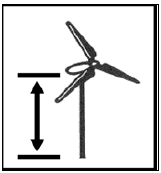
Illustration of system height. - 4. Noise Limit: The sound from the system shall not exceed 55 decibels using the A scale (dBA) measured at the property line in accordance with the methodology described in Section 303A.6.B, except during short term events such as severe wind storms or utility outages.
- 5. Signs: There shall be appropriate signs warning the public that unauthorized access may cause injury or death. Such signs are not to exceed two (2) square feet in size and posted five (5) feet above grade on or near the tower, and shall be oriented to not adversely impact sight lines.
- 6. Access: The tower shall be constructed as a tilt-down or shall not provide step bolts or ladder readily accessible to the public for a minimum height of eight (8) feet.
-
C. Accessory Solar Energy Systems.
- 1. Building-mounted or ground-mounted systems are permitted.
- 2. The accessory solar energy system shall be designed and located to the greatest extent practicable to avoid glare or reflection onto adjacent properties, roadways, and runways, and shall not create a safety hazard.
612.3 Non-Accessory Renewable Energy Systems.
-
A. Non-accessory solar energy systems, bio-gas energy systems, and district energy systems shall be permitted as specified in Table 612.3.
Table 612.3 Renewable Energy System Zoning District Regulations System Type Zoning District Permitted or CUP Building-mounted solar energy system All Permitted* Ground-mounted solar energy system with solar land coverage of 1,500 sq. ft. or less on a lot that meets or exceeds the minimum required area for the respective zoning district All Permitted* Ground-mounted solar energy system with solar land coverage of greater than 1,500 sq. ft., and/or located on a lot that does not meet the minimum required area for the respective zoning district All conditional use permit* Bio-gas energy system IND-L, IND-H, IND-RA, GC, GC-1 conditional use permit District energy system All** conditional use permit* *If located within the Historic District, a Certificate of Approval from the Heritage Commission in accordance with Section 408 shall also be required.
**Permitted in the RL-1, RL-2, and RL-3 Districts when approved as part of a PURD pursuant to Section 501.
-
B. General Criteria.
- 1. No NA renewable energy system shall be erected, constructed, or installed without first receiving a zoning and building permit.
- 2. Renewable energy systems shall be designed and located to the greatest extent practicable to avoid glare or reflection onto adjacent properties, roadways, and runways, and shall not create a safety hazard.
-
C. Conditional Use Permits. If required per Table 612.3, a renewable energy system shall obtain a conditional use permit (CUP) prior to construction and installation. The CUP shall clearly set forth all conditions of approval and shall list all plans, drawings and other submittals that are part of the approved use. Everything shown or otherwise indicated on a plan or submittal that is listed on the CUP shall be considered to be a condition of approval.
- 1. Procedure. An application for a renewable energy system CUP shall be filed with the Planning Board concurrently with an application for site plan review.
-
2. Standards of Review. Following a fully noticed public hearing on the proposed use, the Planning Board may issue a CUP, if it finds, based on the information and testimony submitted with respect to the application, that:
- a. The renewable energy system in its proposed location will comply with all requirements of the Site Plan Review Regulations;
- b. The renewable energy system will not materially endanger the public health or safety; and
- c. The renewable energy system meets the general criteria set forth in Section 612.3.B.
- 3. The Planning Board may require a reasonable setback from the side and front lot lines for a renewable energy system located in the CB and LD Districts.
Section 613 Alternative Treatment Centers.
613.1 Purpose.
The purpose of this section is to establish reasonable regulations for an alternative treatment center (including a cultivation location only) in accordance with RSA 126-X and to protect the health, safety, and welfare of the patrons of such businesses, and of the citizens of the City, and to prevent the deleterious siting of an alternative treatment center within the City.
613.2 Setback Standards.
In addition to meeting the minimum standards enacted by RSA 126-X, an alternative treatment center (including a cultivation location only) shall meet the following setbacks with respect to any listed use, with distances to be measured in a straight line from any listed use to the nearest portion of the building or unit in which an alternative treatment center is located, without regard to intervening structures or other features:
- A. An Alternative Treatment Center shall not be located within 1,000 feet of the property line of a pre-existing public or private elementary or secondary school or designated drug free school zone.
- B. An Alternative Treatment Center shall not be located in or within 1,000 feet of the property line of a pre-existing public playground, public park, pool, or recreation facility.
- C. An Alternative Treatment Center shall not be located in or within 1,000 feet of the nearest portion of any building containing a pre-existing place of worship or religious assembly, or any building containing a pre-existing child care center, including any enclosed or fenced-in playground area directly associated with such child care center.
- D. An Alternative Treatment Center shall not be located in a residential district or within 500 feet of a district zoned: R-1, R-2, R-3, RO, RO-1, PB, RL-1, RL-2, or RL-3.
- E. An Alternative Treatment Center shall not be located in a residential unit or a building which contains a residence.
- F. An Alternative Treatment Center shall not be considered an office use for purposes of this Zoning Ordinance.
Section 614 Recovery Houses.
614.1 Purpose.
The purpose of this section is to institute reasonable regulations for the establishment of recovery houses in accordance with RSA 153:10-d Exemption for Recovery Houses and to protect the health, safety, and welfare of the patrons of such operations, and of the citizens of Lebanon, and to prevent the deleterious siting of recovery houses within the City.
614.2 Certification Required.
To establish and operate a recovery house, the following standards shall be met:
-
A. The recovery house shall be certified and maintain certification by the New Hampshire Partnership of Recovery Residences (NHPRR) at all times while in operation. Documentation of this certification and recertification shall be provided immediately to the Zoning Official, Fire Chief, Police Chief, and the City Clerk.
- 1. A letter from the New Hampshire Partnership of Recovery Residences (NHPRR) confirming the recovery house certification process has commenced shall accompany all City permit applications for the establishment of a new recovery house.
- 2. Upon final New Hampshire Partnership of Recovery Residences (NHPRR) certification of a new recovery house the certification shall immediately be communicated to the Zoning Official, Fire Chief, Police Chief and City Clerk. The recovery house may not begin operation under any City approval until certification has been received and transmitted to the City as required by this section.
- B. A 24-hour emergency contact person with contact information and the approved building occupant load shall be posted in the common area of the building, so it is readily visible to residents and emergency responders. A 24-hour emergency contact person with contact information shall be provided, kept updated and remain on file with the Police Chief and Fire Chief.
614.3 Special Exception Application Requirements.
An application for a Special Exception shall include the following documentation:
- A. A location map demonstrating adherence to the 1320 ft. (1/4 mile) bus stop radius requirement set forth in Section 614.3.
- B. A site plan and floor plan demonstrating adherence to the requirements of RSA 153:10-d Exemption for Recovery Houses.
- C. A letter from the New Hampshire Partnership of Recovery Residences (NHPRR) confirming the recovery house certification process has begun.
-
D. A proposed site plan depicting the following:
- 1. A garbage management plan with locations of exterior garbage receptacles and compliance with the applicable criteria set forth in Section 614.3. If a garbage dumpster is being used, the plan shall demonstrate compliance with the applicable location and screening requirements as set forth in the Site Plan Review Regulations.
- 2. A proposed smoking compliance plan that meets the standards of 153:10-d Exemption for Recovery Houses and the applicable criteria set forth in Section 614.4.
- 3. A parking plan sufficient to demonstrate that the recovery house has sufficient parking to meet the needs of its residents.
614.4 Special Exception Criteria.
In addition to the general Special Exception criteria set forth in Section 801.3 and the certification requirements set forth in Section 614.2, an applicant for a Special Exception shall demonstrate compliance with the following criteria:
- A. The recovery house will be operated in a manner harmonious to the neighborhood and shall maintain a residential home appearance from the street view.
- B. The recovery house shall have walkable and bikeable access to and be located within 1/4 mile (1320 ft.) of a bus stop.
- C. Smoking areas are not permitted in the front yard of a recovery house.
- D. A designated smoking area shall meet applicable setback for the zoning district and if abutting a residential use screening shall be provided.
- E. All garbage receptacles shall be stored in a location on the side or rear of the house.
Section 615 Mobile Food Service.
- A. The purpose of this section is to provide opportunities for mobile food service vending and stand vending within certain non-residential areas in the City.
- B. Mobile food service vending and stand vending shall be a permitted use in the Central Business, Lebanon Downtown, General Commercial, General Commercial-One, Light Industrial, Medical Center and Medical Center - 2 Zoning Districts provided the following standards are met:
-
C. Prior to beginning operations, property owner(s) must obtain a Zoning Permit which shall be valid for one (1) year. An application for a Zoning Permit shall include the following:
- 1. A site drawing of the property identifying existing and proposed conditions.
- 2. The location of the mobile food service vendors and stand vendors, utility connections, and compliance with setback requirements.
- 3. The location of any seating, tables garbage receptacles or similar customer amenities.
- 4. A safety plan for each mobile food service vendor and stand vendor. The plan shall include the location of barriers, caution cones, or similar safety items that are to be deployed to ensure that patrons can safely interact with the mobile food service unit or stand vendor. Safety measures shall be scaled to protect patrons based upon traffic conditions.
- 5. A site parking calculation showing the total number of parking spaces on the site, the number and location of parking spaces assigned to each of the mobile food service vendors and stand vendors upon the lot.
- 6. Hours of operation, and days of the week and months of operation. Operation of a mobile food service vendor and stand vendor is limited to the hours between 7:00 AM and 9:00 PM daily.
- 7. The location of sandwich boards signs if applicable.
- 8. Written permission of the landowner consenting to the proposed operation.
- 9. Identify a plan for the disposal of wastewater and garbage.
- 10. The landowner may reapply for a Zoning Permit on an annual basis.
-
D. Mobile food service vendors and stand vendors shall not:
- 1. Be located within 25 feet of a handicap accessible parking space, fire hydrant, fire escape, bus stop, loading zone, driveway entrance or a residential district.
- 2. Be located in a manner that creates hazardous travel conditions or impedes the operations of police, fire, or emergency services, or the flow of automobile traffic or pedestrian traffic.
- 3. Block access to or occupy any portion of any handicap accessible parking space or access ramp.
- 4. Utilize an open fire without permission of the property owner and a permit from the Lebanon Fire Department.
- 5. Shout, make an outcry, blow a horn, ring a bell, or use any other sound device for the purpose of attracting attention to any goods which the vendor proposes to sell.
- 6. Inappropriately dispose of wastewater and garbage including but not limited to dumping in open stormwater drains.
- E. Utilities for mobile food service units and stands shall be self-contained and shall not connect to City sewer and water nor dispose of waste in storm sewers. External portable generators or other noise emitting equipment shall not be operated prior to 9:00 AM on weekdays and Saturdays nor prior to 12:00 noon on Sundays and must not operate after 9:00 PM daily.
-
F. The maximum number of mobile food service units and stands allowed on any one lot shall be determined by the lot size and the amount of available space on the lot.
- 1. For lots that require more than 40 parking spaces per Section 607, mobile food service unit(s) and/or stand(s) may be located in parking areas. No more than 10 percent (10%) of parking spaces may be utilized to locate mobile food service units and stands. A minimum of 4 parking spaces and a maximum of 6 parking spaces per vendor shall be provided.
- 2. For lots with fewer than 40 parking spaces per Section 607, one mobile food service unit and / or stand is permitted. A minimum of 4 parking spaces must be available to accommodate the use.
- 3. On lots with fewer than 40 parking spaces, one mobile food service units and stand and shall provide a minimum of 2 off street parking spaces for patrons.
- G. Notwithstanding the provisions of Section 608.6 (Temporary Signs), mobile food service units and stands are limited to the placement of no more than 2 sandwich board signs for each mobile food service unit and stand when the operation is open. Feather flags, balloons, inflatables, pennants, ribbons, streamers, and spinners or other similar devices which may move or swing as a result of wind pressure are prohibited.
- H. Utilization of a public right of way or public property for operation of a mobile food service unit or stand is permitted pursuant to Chapter 179 Vendors of the City Code. The City of Lebanon Recreation, Arts and Parks Department in conjunction with the City Manager's Office may permit mobile food service units and stands within the confines of a city park or city recreation facility irrespective of the underlying Zoning District.